August 17, 2026
Beyond Competition: What Ontario’s Tire Recycling System Really Needs
On July 7th, the Competition Bureau posted a response to proposed amendments by the Ministry of Environment, Conservation and Parks. The bureau’s comments, while notably one-sided, reinforce the value of competition in sustaining healthy markets. Surprisingly, the post also highlights a concern many stakeholders have raised for some time: Ontario’s recycling framework needs clearer rules for where competition is appropriate and where coordination is required.
The broader debate has become focused on whether a recycling system should be competitive or “monopolistic,” rather than on the conditions required for competition to function effectively. That framing risks misusing the word monopoly. For example, in all other Canadian provinces, one not-for-profit organization is assigned responsibility for managing tire recycling and delivering system-wide accountability; however, that does not mean competition is absent. Competition occurs at the service-provider level, including collection, hauling, processing, and end-market development. Across Canada, this model has helped achieve some of the highest tire recycling rates in the world, precisely because it combines clear accountabili...
Read more
August 12, 2026
From Highway to Hockey Rink: How Tires Are Recycled Into New Products
The advent of modern transportation comes with an unavoidable consequence: mountains of rubber tire waste. A billion tires are discarded each year globally. Beyond the obvious material waste challenge, old tires pose hazards if improperly discarded, from fire risk to creating an ideal breeding ground for mosquitoes in the summer.
Scientists have yet to figure out how to recycle old tires into new ones at scale, but they can still find valuable second lives in new rubber products. We took a peek behind the tire recycling curtain to find out what really happens to tires when they retire and where they go next.
How is Tire Rubber Collected?
Given the environmental and public health risks associated with improperly discarded tires, jurisdictions around the world have put laws on the books to incentivize tire recovery and recycling. Among those legislative models is individual producer responsibility, or IPR, a model unique to Ontario when l...
Read more
August 06, 2026
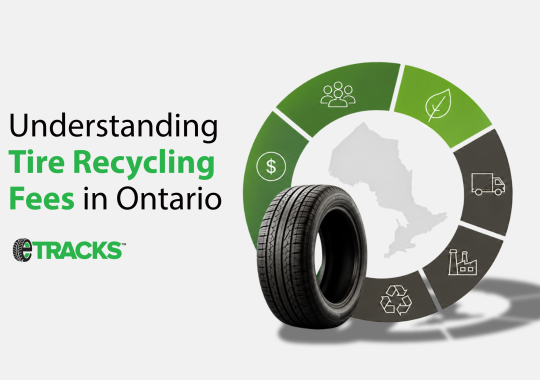
Understanding Tire Recycling Fees in Ontario
Ontario does not have a single, standardized tire recycling fee. The amount consumers see at the point of sale can vary depending on the tire producer, supplier, retailer and the compliance service model used by a Producer Responsibility Organization (PRO). This means a fee charged at the register is not a province-wide recycling rate.
This overview explains how tire recycling fees work in Ontario, where eTracks fits in, and why accurate fee attribution matters for producers, retailers and consumers.
How Tire Recycling Is Managed in Ontario
Ontario tire recycling has been regulated under the Resource Recovery and Circular Economy Act, 2016 (RRCEA) since 2018 and operates under an Individual Producer Responsibility (IPR) model. Under the Tires Regulation, tire producers – including manufacturers, automakers and importers – are responsible for managing the collection and recycling of the tires they supply into the Ontario market. To meet their regulatory obligations, most tire producers work with a Producer Responsibility Organization (PRO), such as eTracks, to support compliance, logistics and reporting. PROs are not government entities; they are private businesses operating in a competitive market. The PRO market is diverse, with five of the six PROs operating as for-profit entities, some vertically integra...
Read more
July 30, 2026
Where the Rubber Meets the Road: Recycled Tires Make Roads Quieter, Greener and Longer Lasting
A growing number of used tires are finding a second life on the road. Adding recycled rubber to the asphalt mix for paving roadways comes with a range of perks for drivers and the environment while keeping end-of-life tires out of landfills. As the only not-for profit tire PRO in Ontario, eTracks hopes to see greater adoption of applications like rubberized asphalt, where an increasing volume of end-of-life are utilized in ways that are both economical and environmentally positive.
Rubber-modified asphalt made with tires is shown to reduce traffic noise, improve vehicle fuel economy, and create fewer lifecycle greenhouse gas emissions compared to conventional asphalt. It also provides a viable end market for the billion tires discarded annually around the world, reducing waste and ...
Read more
July 20, 2026
Keeping Ontario’s Tire Recycling System Moving Through Disruption
Proportionate Tire Collection Where it Matters Most
Ontario’s tire recycling system is based on each producer meeting specific requirements to collect and recover a certain tonnage of tires, also known as a Minimum Management Target (MMT) and to ensure they ‘manage and operate’ a compliant collection network across the province. The MMT is calculated based on the producer’s sale to market from the previous 3, 4 and 5 years, and can be met through reuse, retreading or processing (e.g. “crumbing”), each having a different recovery rate*.
*Recovery Rate: In tire recycling, a recovery rate is the percentage of old, discarded tires that are successfully collected and put to a useful new purpose instead of going to a landfill. This includes tires made into new products, re-used or retreaded.
Once tires reach their end-of-life (EOL), it’s neither operationally nor economically feasible to separate and collect millions of tires by brand (individual producer, importer or automaker). Instead, collection occurs from physical sites where tires accumulate, with producer obligations measured by weight rather than brand.
During the current surge in Ontario scrap tire volumes, eTracks looks beyond minimum regulatory targets by collecting in proportion of its producer customers overall ...
Read more
April 11, 2026
Tire Recycling Reduces Hazardous Emissions into the Environment
Comparing the effects of recycling tires to those of utilizing new materials to make the same product, an ongoing study demonstrates that recycling tires prevents harmful emissions.
For information on eTracks’ tire recycling initiatives, view the most recent LCA Report: Scrap Tire Life Cycle Assessment (updated to include 2024 data).
Fulfilling producer obligations under Ontario’s Resource Recovery and Circular Economy Act (RRCEA) and Tire Regulation 225/18 entails offering services to producers that guarantee they reach their legal goal of collecting and recycling all used tires they sell as Tire Derived Product (TDP). The more traditional usage of new, or “raw” resources to create things is replaced by a TDP.
Compared to the use of (new) resources they replace, consumers anticipate that items created from recycled tires will have a positive environmental impact. In order to quantify this expectation, seven members of the Canadian Association of Tire Recycling Agencies (CATRA) voluntarily participated in the benchmark study known as the “Scrap Tire Life Cycle Assessment (LCA)”. Pa...
Read more
March 03, 2026
Free tire disposal and the role of tire collection sites in Ontario
Find an eTracks Collection Site
Are you a consumer who needs to dispose of your used tires?
Please visit the eTracks homepage and select the “Find a collection site” tab. This will allow you to search our database and find the closest eTracks enrolled collection site near you. We advise calling the collection site ahead of time to verify their business hours and to let them know you’re bringing your tires over to drop off.
Ontario has amended producer responsibility regulations for tires to increase flexibility, reduce burden and simplify requirements for producers. While these updates do not change the consumer experience, collection and drop-off services remain free; they do change how producers and PROs demonstrate compliance under the updated 2025–2029 framework.
Tire Collection in Ontario
Tire recycling is regulated under the Resource Recovery and Circular Economy Act (RRCEA) in Ontario. The Act, and the Tire Regulation 225/18 within the Act, specify that under the Individual Producer Responsibility (IPR) model c...
Circular economy ,
climate change ,
emissions ,
EPR ,
IPR ,
ontario ,
Producer Responsibility Organization ,
recycling ,
repurpose ,
RRCEA ,
tire change ,
tire collection ,
tire recycling
Read more
October 30, 2025
Highlights from CATRA’s 2025 Annual Members Meeting
Reflecting on Leadership and Collaboration:
Earlier this month, members of the Canadian Association of Tire Recycling Agencies gathered in Calgary, Alberta, for the 2025 Annual Members Meeting. Hosted at the historic Fairmont Palliser, the two-day event brought together representatives from ten provincial agencies, partners, and industry stakeholders for a productive exchange of insights, progress, and ideas shaping the future of end-of-life tire management in Canada.
This year’s meeting also marked a meaningful milestone, eTracks concluded two terms (four years) as the Chair of CATRA, a period defined by collaboration, innovation, and measurable results across the national network. Under eTracks’ leadership, CATRA strengthened its data-driven approach, advanced national performance tracking, and deepened its commitment to circular economy outcomes.
Building on the achievements highlighted in CATRA’s 2024 Annual Report, discussions in Calgary centered on the organization’s ongoing three-year strategic plan. Members shared updates tied to CATRA’s Value Areas, including compliance efforts, enhanced reporting and analytics, and continued development of sustainable end markets for recycled materials. The sessions also included a review of financials, approval of the 2025 budget, and collaborative planning for the year ahead.
Read more