The advent of modern transportation comes with an unavoidable consequence: mountains of rubber tire waste. A billion tires are discarded each year globally. Beyond the obvious material waste challenge, old tires pose hazards if improperly discarded, from fire risk to creating an ideal breeding ground for mosquitoes in the summer.
Scientists have yet to figure out how to recycle old tires into new ones at scale, but they can still find valuable second lives in new rubber products. We took a peek behind the tire recycling curtain to find out what really happens to tires when they retire and where they go next.
How is Tire Rubber Collected?
Given the environmental and public health risks associated with improperly discarded tires, jurisdictions around the world have put laws on the books to incentivize tire recovery and recycling. Among those legislative models is individual producer responsibility, or IPR, a model unique to Ontario when looking across Canada at the more commonly employed systems of extended producer responsibility and stewardship. IPR is a more stringent version of EPR, and requires tire producers to ensure their products are disposed of responsibly or recycled.
Canada’s most populous province, Ontario, has some of the most stringent IPR requirements for tires globally. Producers are responsible for collecting and recycling the tires they sell in the province (by weight, not by brand), which requires an auditable record of where tires are collected and where they go in their subsequent lives.
As a not-for-profit eTracks was established to help tire producers meet the needs of Ontario’s IPR laws. With a network of 5,500 tire collection sites like auto dealerships, repair shops and tire dealers, eTracks now collects and traces tires across the province, which spans an area 1.5 times the size of Texas.
eTracks tracks and traces about 13 million tires every year using its eSRP system, which digitally verifies tires from pickup at collection sites to drop-off at processing facilities.
Among those manufacturers is Northwest Rubber, a top global producer of rubber mats and one of eTracks’ largest manufacturing partners. Northwest uses recycled rubber for the majority of the products it makes, and all of that recycled rubber comes from end-of-life tires, a significant portion provided by eTracks, says CFO David Pruim.
The company even owns its own tire processing plant, Evolve Recycling in Brantford, Ontario, which has won eTracks’ processor award several years in a row. The plant recycles millions of tires every year and turns them into new products for sports, agriculture and industry.
Follow the crumb trail: How end-of-life tires become new products
When tires arrive at the Evolve Recycling plant, they’re separated into their three basic components: steel, fibers and rubber.
Once separated, the rubber is sent through powerful grinding machines that crush it into small fragments. Then comes cleaning: Magnets and air-suction systems are used to extract any remaining steel wire, textile fibers and debris from the rubber.
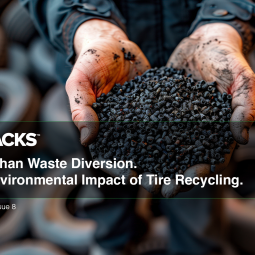
The clean rubber fragments that remain are processed again in secondary grinders to create uniform pellets called crumb rubber, which is ready to use as a raw material in new products.
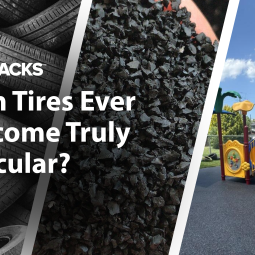
Different sizes of crumb rubber are best suited for different purposes. Coarser crumbs are widely used for sports surfaces, for example, but specialized products like Northwest Rubber’s often require additional processing.
“If you’ve played soccer or football on an artificial turf field, the same rubber pellets that you see on that surface is what we get,” said Pruim of Northwest Rubber. “We then put that in the press, along with a couple of other ingredients, and we produce rubber flooring.”
Since its founding nearly 60 years ago, Northwest has turned more than 160 million tires into new products. Northwest brand Animat, for example, specializes in manufacturing recycled rubber matting for livestock and equestrian facilities to improve animal welfare.
The mats increase comfort for horses and cows inside barns and transport trailers, reducing incidence of injury. For the dairy industry in particular, increased cow comfort has been linked to increased milk production in studies that compare rubber flooring to standard concrete.
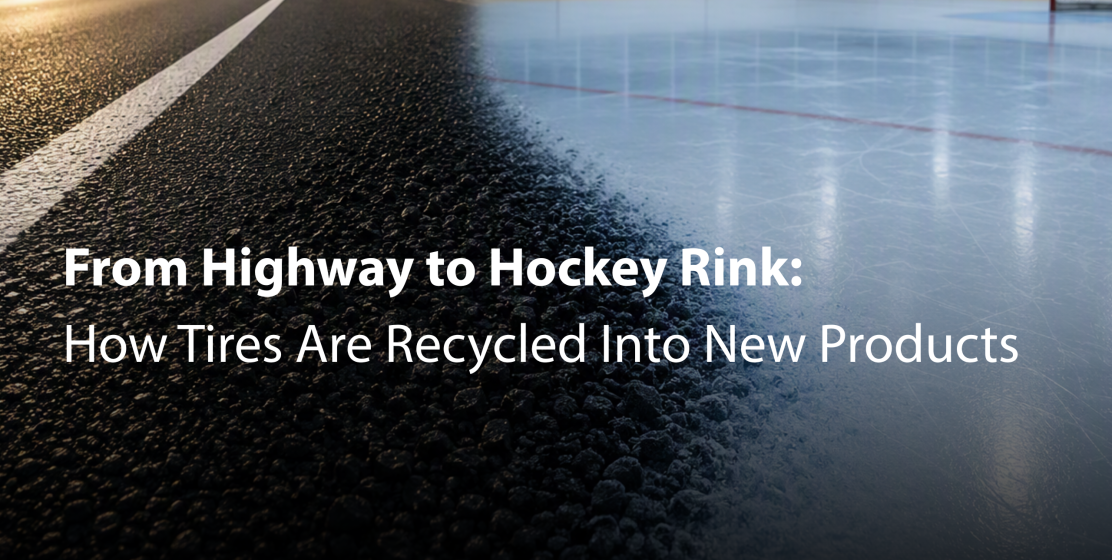
Northwest also makes sporting floors for hockey rinks and fitness gyms, anti-fatigue mats for commercial kitchens, auto mats for cars and trucks, and landscaping and construction materials, among other common items — all from recycled tire rubber.
The tire industry is becoming more circular, but not quite there yet
Some jurisdictions consider tires recycled once they have been transformed into rubber crumb at a recycling depot, but in Ontario, tires are only considered recycled once that rubber is sold onward for some beneficial purpose. When Northwest Rubber receives rubber crumb, it’s logged in the eSRP platform to help tire manufacturers comply with their IPR requirements.
“For us, it’s critical that we know where the material comes from in Ontario and where it ends up. A tire isn’t truly recycled just because it’s been shredded – it has to become part of something useful again,” Melissa Carlaw, VP Communications and Sustainability, eTracks.
While Ontario’s IPR laws reduce tire waste and the need for virgin rubber feedstocks, they don’t ensure the products made from that rubber are collected and reused a second time. “It could be done,” Pruim said of recycling Northwest’s mats. “We just don’t have another mechanism in the market to recover those used mats, clean them and grind them up. It’s more of a logistical challenge, frankly, than anything else.”
The industry, however, is rolling in the right direction with producer responsibility laws that advance circularity and organizations like eTracks and Northwest Rubber that give new life to used tires.