September 16, 2026
The Recycling Journey Doesn't End at Collection: End Markets
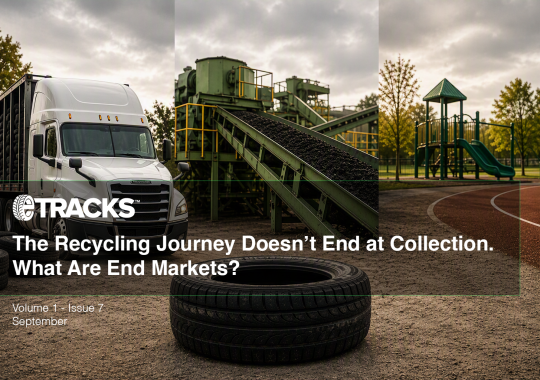
The Recycling Journey Doesn’t End at Collection
Used tires shouldn’t end up in a ditch, illegal dump site, or landfill. These tires can and should be recycled. But here’s something that often gets overlooked: Collecting a tire isn’t the same as recycling it.
Collection is just the first step. A tire’s path from end-of-life to new life involves several important stages, including transportation, processing, manufacturing, and ultimately a new beneficial use. Without that final step, the recycling process remains incomplete.
That’s where end markets come in.
What Are End Markets?
An end market is the final destination for end-of-life tires. For end-of-life tires, end markets are the products and applications that utilize the materials recovered during the recycling process. They create demand for recycled materials and ensure those materials continue delivering value long after a tire’s original purpose has ended.
Without end mar...
Read more
March 03, 2026
Free tire disposal and the role of tire collection sites in Ontario
Find an eTracks Collection Site
Are you a consumer who needs to dispose of your used tires?
Please visit the eTracks homepage and select the “Find a collection site” tab. This will allow you to search our database and find the closest eTracks enrolled collection site near you. We advise calling the collection site ahead of time to verify their business hours and to let them know you’re bringing your tires over to drop off.
Ontario has amended producer responsibility regulations for tires to increase flexibility, reduce burden and simplify requirements for producers. While these updates do not change the consumer experience, collection and drop-off services remain free; they do change how producers and PROs demonstrate compliance under the updated 2025–2029 framework.
Tire Collection in Ontario
Tire recycling is regulated under the Resource Recovery and Circular Economy Act (RRCEA) in Ontario. The Act, and the Tire Regulation 225/18 within the Act, specify that under the Individual Producer Responsibility (IPR) model c...
Circular economy ,
climate change ,
emissions ,
EPR ,
IPR ,
ontario ,
Producer Responsibility Organization ,
recycling ,
repurpose ,
RRCEA ,
tire change ,
tire collection ,
tire recycling
Read more
October 30, 2025
Highlights from CATRA’s 2025 Annual Members Meeting
Reflecting on Leadership and Collaboration:
Earlier this month, members of the Canadian Association of Tire Recycling Agencies gathered in Calgary, Alberta, for the 2025 Annual Members Meeting. Hosted at the historic Fairmont Palliser, the two-day event brought together representatives from ten provincial agencies, partners, and industry stakeholders for a productive exchange of insights, progress, and ideas shaping the future of end-of-life tire management in Canada.
This year’s meeting also marked a meaningful milestone, eTracks concluded two terms (four years) as the Chair of CATRA, a period defined by collaboration, innovation, and measurable results across the national network. Under eTracks’ leadership, CATRA strengthened its data-driven approach, advanced national performance tracking, and deepened its commitment to circular economy outcomes.
Building on the achievements highlighted in CATRA’s 2024 Annual Report, discussions in Calgary centered on the organization’s ongoing three-year strategic plan. Members shared updates tied to CATRA’s Value Areas, including compliance efforts, enhanced reporting and analytics, and continued development of sustainable end markets for recycled materials. The sessions also included a review of financials, approval of the 2025 budget, and collaborative planning for the year ahead.
Read more
October 25, 2023
Tire Recycling Helps Avoid Harmful Emissions
Tire Recycling Helps Avoid Harmful Emissions
An ongoing study confirms that tire recycling avoids harmful emissions when compared to the impacts of using new materials to create the same products.
Read the most current LCA Report for eTracks tire recycling efforts: Scrap Tire Life Cycle Assessment (updated to include 2021 and 2022 data)
Meeting producer obligations under Ontario’s Resource Recovery and Circular Economy Act (RRCEA) and Tire Regulation 225/18 means providing services to producers that ensure they meet their regulatory target to collect and recycle 100 per cent of the used tires they sell into the marketplace. This includes transporting them to processing facilities and verifying how they are repurposed into new products for approved use in the marketplace as a Tire Derived Product (TDP). A TDP displaces the more conventional use of new, or “raw” materials used to make products.
People expect that products made from recycled tires will deliver ecological benefits when compared to the use of (new) materials they displace. Putting numbers to this expectation was at the heart of the “Scrap Tire Life Cycle ...
Circular economy ,
climate change ,
emissions ,
EPR ,
IPR ,
ontario ,
Producer Responsibility Organization ,
recycling ,
repurpose ,
RRCEA ,
tire recycling
Read more