October 30, 2025
Highlights from CATRA’s 2025 Annual Members Meeting
Reflecting on Leadership and Collaboration:
Earlier this month, members of the Canadian Association of Tire Recycling Agencies gathered in Calgary, Alberta, for the 2025 Annual Members Meeting. Hosted at the historic Fairmont Palliser, the two-day event brought together representatives from ten provincial agencies, partners, and industry stakeholders for a productive exchange of insights, progress, and ideas shaping the future of end-of-life tire management in Canada.
This year’s meeting also marked a meaningful milestone, eTracks concluded two terms (four years) as the Chair of CATRA, a period defined by collaboration, innovation, and measurable results across the national network. Under eTracks’ leadership, CATRA strengthened its data-driven approach, advanced national performance tracking, and deepened its commitment to circular economy outcomes.
Building on the achievements highlighted in CATRA’s 2024 Annual Report, discussions in Calgary centered on the organization’s ongoing three-year strategic plan. Members shared updates tied to CATRA’s Value Areas, including compliance efforts, enhanced reporting and analytics, and continued development of sustainable end markets for recycled materials. The sessions also included a review of financials, approval of the 2025 budget, and collaborative planning for the year ahead.
Read more
September 15, 2022
How Tires are Made
How Tires are Made: Blending chemistry, physics & engineering to make and recycle tires
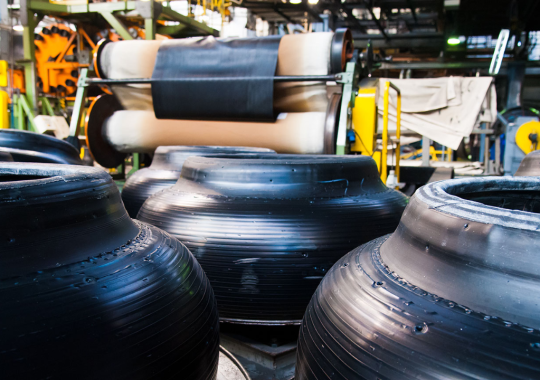
Ever wonder how your car tires were made? The basic steps of tire manufacturing start with intensive planning and design to customize each tire model to meet the stresses and performance requirements to match a particular vehicle. The production process begins with the selection of several types of rubber along with special oils, carbon black, pigments, antioxidants, silica, and other additives that are combined to provide the exact characteristics for each class of tire. The assembly of the tire includes an inner liner, body plies and belts, bronze coated steel wire strands, and finally, tread and sidewalls. After being pressed together, the end result is called a “green” or uncured tire.
In the last step the green tire is placed inside a mold and inflated so it forms to the tread. Then it is heated to more than 300 degrees Fahrenheit for twelve to fifteen minutes, vulcanizing it to bond the components and cure the rubber. Tires are then inspected, and sample tires are randomly tested, x-rayed, cut apart to look for flaws, run on test wheels, or road-tested to evaluate handling, mileage and traction performance.
Read more
August 16, 2022
What is natural rubber and why should we care?
What is natural rubber and why should we care? The future of rubber and the case for innovation in the tire industry.
The Individual Producer Responsibility (IPR) model used in Ontario is intended, among other things, to spur innovation at the manufacturing level, to drive innovation that reduces waste, and increase the recyclability and re-useability of the products we use in our homes and businesses. The tire industry is embracing this need in several ways, including, the exploration of new tire material options, developing more efficient tires and of course, ensuring that tires are responsibly recycled and repurposed into new products.
To examine this, let’s begin and the beginning. Imagine a world without rubber, without tires, where planes couldn’t land, and cars couldn’t drive…What would happen? Let’s start by exploring the intriguing history of rubber, its contribution to the tire industry, and the inevitable transformation and innovation that is occurring on account of its finite supply.
Read more